Playing Solo and the Journey There (part of the How Do U Solo? Collection)
[This post is part of a collection of posts on itch and external blogs about people's experiences with solo gaming called How Do U Solo? (HDUS in short), focused on helping people start and continue playing solo TTRPGs.
You can find links to the posts on itch here: https://itch.io/c/7456721/how-do-u-solo
And links to posts on external sites are collected here: https://amag111.itch.io/hdus-external-links]
One of the biggest challenges of solo TTRPG play (or maybe THE biggest) is the question that gets asked regularly on reddit, discords, and all kinds of social media: How do I even do that? followed and associated with the question of How do I start?
Well, the answer is as easy as it is frustrating. You just do. Sit down, remove as many of your typical distractions from your immediate vicinity as you can, and just play. The first thing you need to remember about solo play is that it's solo. It's for you. Nobody else participates or even needs to know about it. It can be imperfect and that is absolutely okay and part of the deal.
But I'm getting a bit ahead of myself here, and since that advice up there can come across as a bit cheeky, I'll also talk about my personal journey to a setup that has helped me in the past and can help you to get yourself to the point where solo play isn't just a daydream, but an actual reality, and where it's going to be a lot of fun: The right playstyle for you, the right game and the right mindset. Now, I'm not saying you need to find one set of these and stick with it forever. But you need one set that works for you to start, and then, once you're in the flow of things, it's much easier and enjoyable to branch out and do other things.
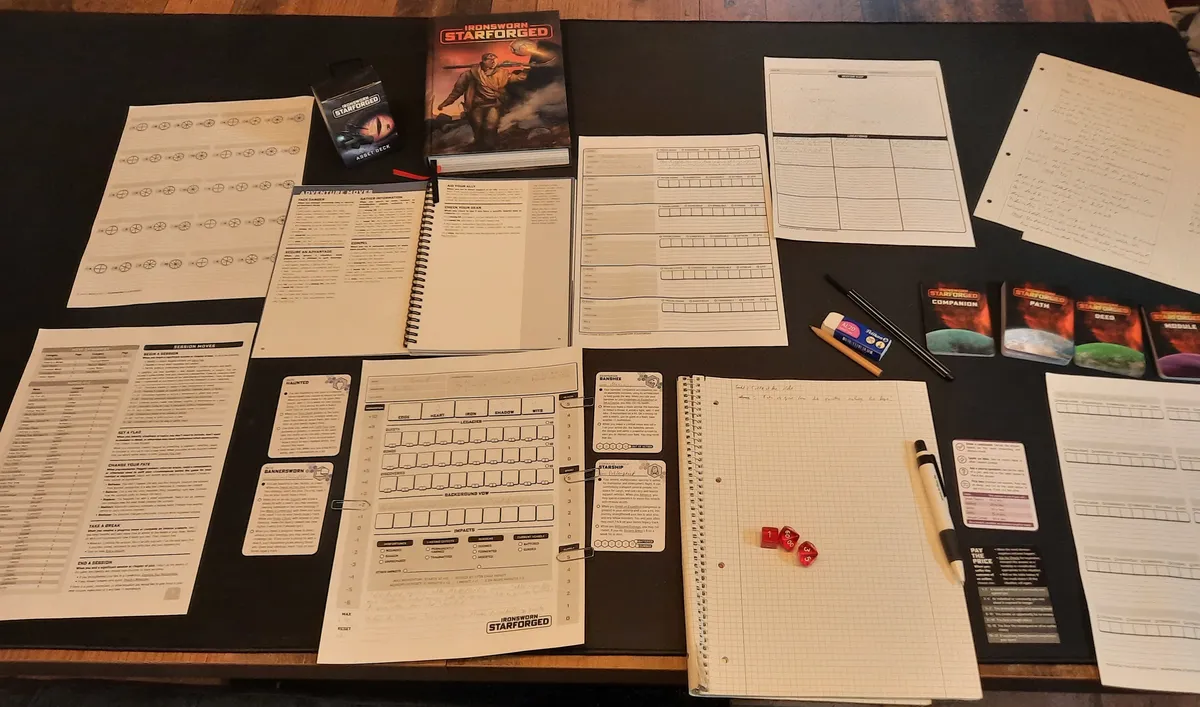 This is the kind of full out spread I started with while playing Starforged. Kind of unwieldy, huh?
Playstyle
What I mean about playstyle is the way you keep a record of your game, and of the three topics I'm going to discuss here, this is also the one that's going to take you the longest time to figure out (at least it was for me). What you'll need to keep in mind are your personal preferences as well as circumstances. I never find the time to sit down and play a long session (meaning upwards of sixty minutes). Most of my play takes place in 15–30-minute bursts really early in the morning before work, during a lunchbreak, late at night before bedtime. Things like that. So, what I can't do is create elaborate setups that need time to put on the table, using miniatures, maps and props (believe me, I tried). I like doing that, but if I try to incorporate that into my solo play, it just eats too much time, so I mostly save it up for my regular group games that have more time allocated to it. What I have explored instead are different ways of making my games portable, and easy to pull out and put away. I'll show you the evolution, so to say.
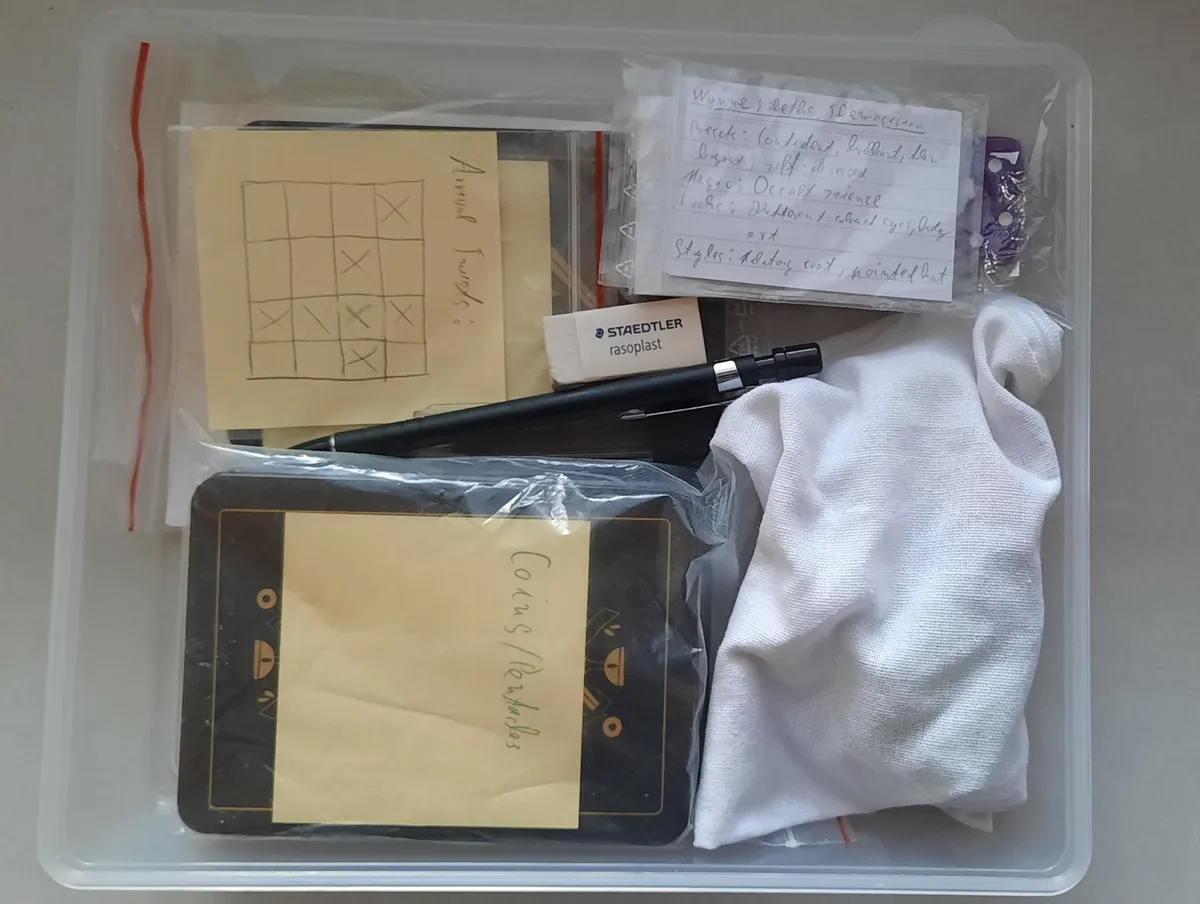 Neat and tidy, except for my handwriting.
This up here is my packed in kit for Koriko (which I still need to finish someday, shame on me...). Everything fits neatly into a plastic lunchbox roughly the size of A5. It needs a bit of puzzling the first time around, and a bit of jostling here and there but it all fits. Everything one needs to play Koriko: Dice (I used the alternative dice bag method instead of stacking, because stacking doesn't really work with short game times), tarot cards sorted into different baggies, small cards for the characters I've met as well as post its for the twist grids, and finally a mechanical pencil, an eraser, and a stack of paper for the current chapter (I store all finished chapters in a different place). Here you can see it all laid out:
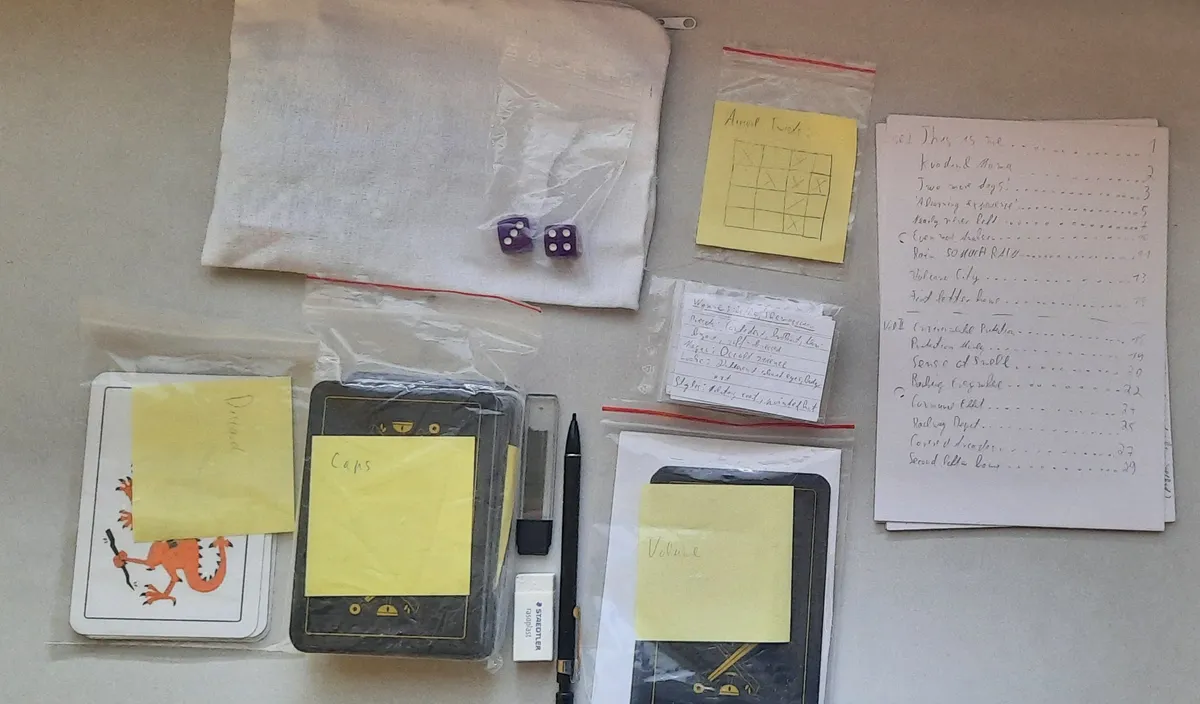
The only thing missing is the rulebook, for two reasons. Firstly, printing it all out would have used about the same space as the kit, making it much less portable, and secondly, you don't really need the whole rulebook while playing. The rules themselves are very easy, and with short gametime like I have, I need to refer to it once or twice to see what my cardpulls are about, so I mainly kept them digitally on my phone.
While the Koriko kit worked perfectly, the one thing that annoyed me a bit was the size still. So, I wondered if I could create something even smaller - and so I did. This time for Wanderhome, which isn't a solo only game, but can easily be played solo due to the fact that it is so rules light that the rules nearly don't exist (I'm exaggerating a bit, but just a bit). As you can guess, printing the rulebook wasn't really necessary either, but Wanderhome has a number of sheets to fill in for your character, the Kith you meet, the places you visit and the seasons that pass. I printed a differing number for those four, got one of my dice sets (not necessary for Wanderhome, but I wanted to have something handy for oracle rolls) as well as some tokens, an A6 notebook and another mechanical pencil and fit it all into a single box:
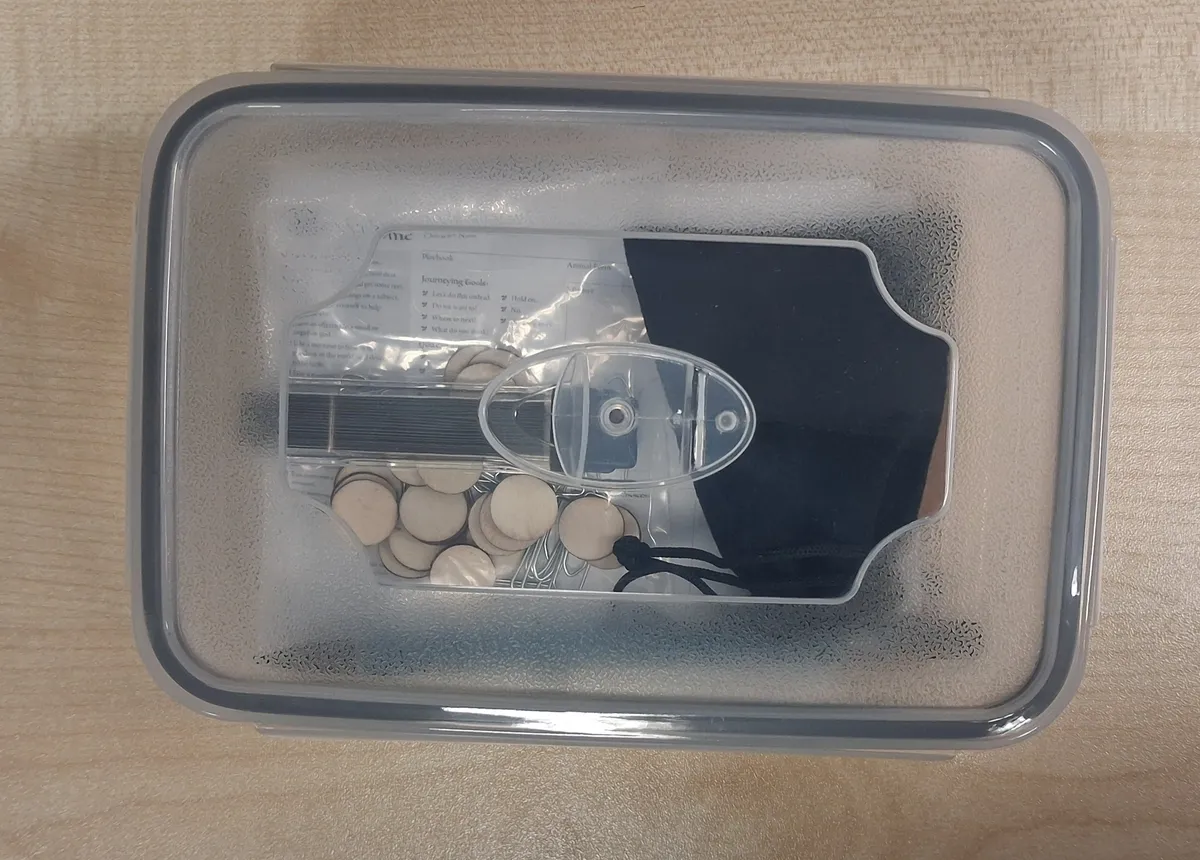 Sooooo tiny.
This is roughly half the size of the Koriko kit and fits into the side pockets of cargo pants. It’s extremely portable and extremely easy to put anywhere there's just a bit of space, just like this:
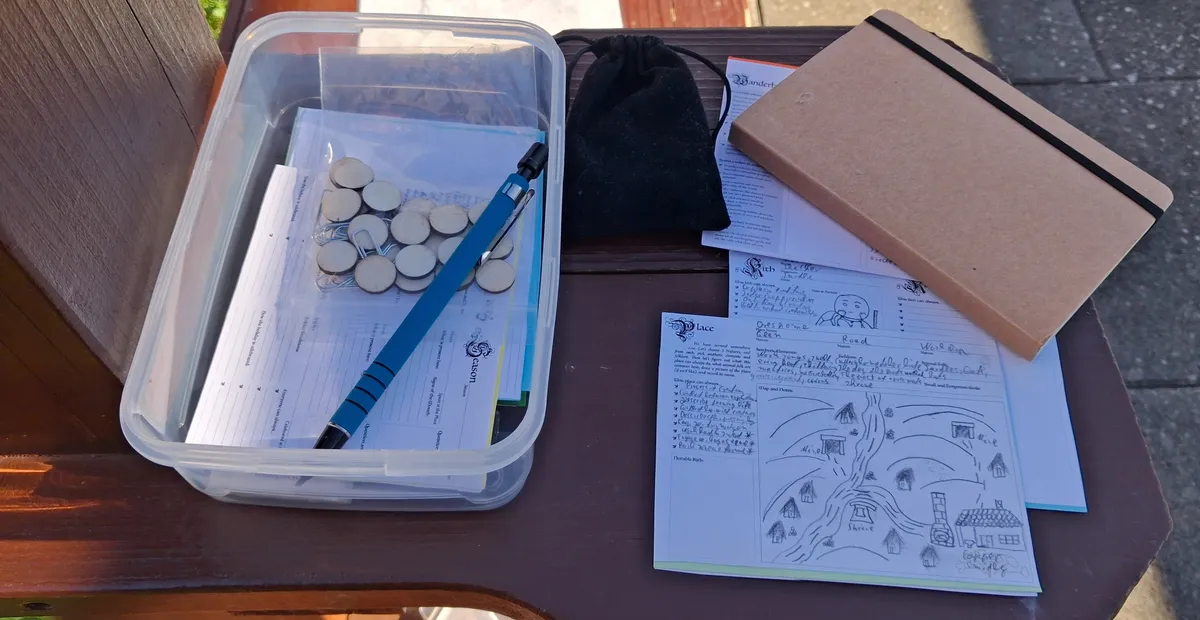 The one thing I miss about my current digital setup is drawing maps and things by hand.
The biggest problem here? How damn tiny the writing was. My handwriting is hard to read on the best of days, and writing as small as I needed to fit everything here made my records extremely intelligible. So, after a short game of Notorious/Outsiders (still on paper only) and some other games in between, before and after what I’ve mentioned here, I returned where I started my solo journey: Writing digitally. I originally had set out to play without devices to reduce my screentime, but the fact that my handwriting is horrendous, as well as this little blog of mine made me return to digital note keeping, and thanks to a tablet with a keyboard I bought (roughly the size of A5/the Koriko kit when folded), I'm still very free in where I play and only need to carry some dice/cards/whatever the game I'm playing requires me to.
All of this to say: It can and will take you a while to find your perfect style of play and setup, and I haven't even talked about how you might keep notes: Recording yourself and transcribing later, just writing bullet points, writing full form prose and everything in between is absolutely doable. I've settled on full form prose quite early on (I tried bullet points and only rough prose as well), but I hate going over my notes a second time to write them out, so I simply write it out in the amount of detail I want right away (so the solo games you can read here are 95% in the state I wrote them in while playing, with only minimal corrections before posting it).
Choice of game
Okay, on to choosing the right game to solo/for you. This is going to be much shorter in writing, but if you're prone to decision paralysis might be your biggest problem: Jumping to and from games all the time (I tended to do that too, but switching over to shorter games as well as writing for the blog help keep me focused nowadays).
When talking types of games, from the perspective of solo TTRPG gaming, I tend to categorize games into three categories, though there is quite a bit of overlap between them: Games that are barely games and closer to writing exercises (like the mentioned Koriko and Wanderhome), often referred to as Journaling games, TTRPGs with a set of rules that are made to solo (like the Ironsworn family of games), and TTRPGs that weren't made to solo (so, pretty much all the big names like DnD).
Starting out I would discourage you from the third category. Yes, it does work (I played both Fabula Ultima and Twilight Sword solo without both of them having their official solo supplements yet), but it requires a certain amount of thinking around the rules, homebrewing and changing things to make it work, the amount of it depending on the game. That's not something you should burden yourself with the first time playing in my opinion. It distracts you from actually sitting down and playing. It's something you can easily do once you get into the rhythm of solo play, though. Instead, think about the kind of game you'd like to play and then try to find a game that fits that. If you want to play DnD, maybe look at Four Against Darkness, for example. If you want a storytelling focused game with little rules, a journaling game might be up your ally (Like Koriko, Thousand Year Old Vampire, Pilgrimage of the Sun Guard), and if you want something rules-lite that bridges those two categories, Notorious/Outsiders or Ion Heart might be up your alley. The choice is enormous, honestly, so asking around a bit for recommendations can really help (feel free to send me a mail if you read this far and want me to give you some ideas/help!).
And of course, you can never go wrong with Ironsworn, Starforged or Sundered Isles, since those games really do take you by the hand to help you ease into the game and their large-ish amount of rules (in my opinion).
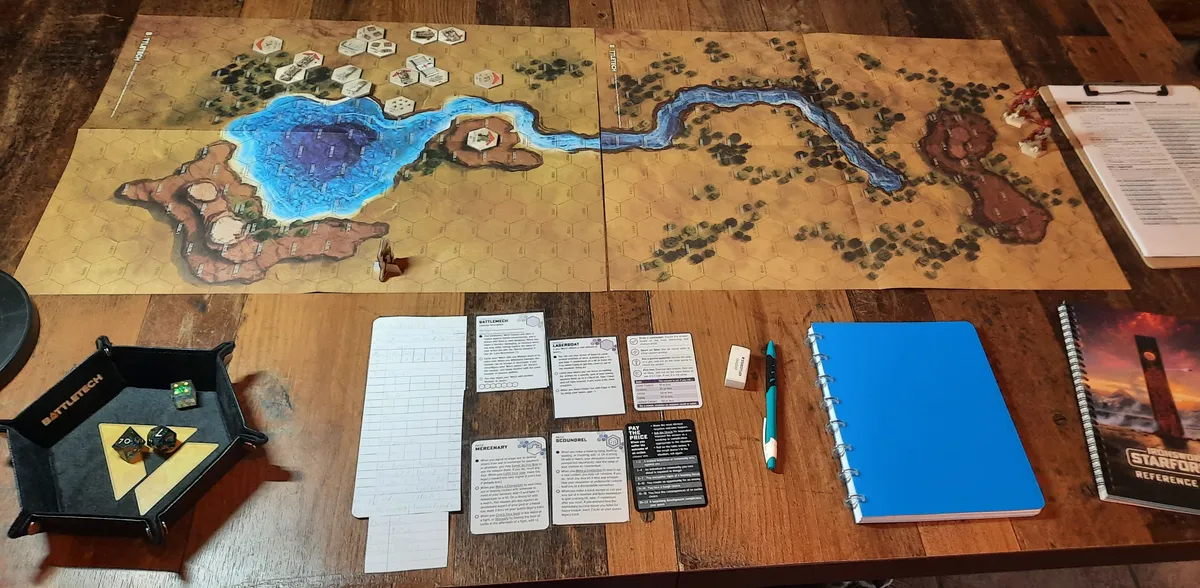 A large spread of when I was playing around with crossing BattleTech with Starforged, so I could use my painted miniatures for gaming, instead of only having them packed away.
Mindset
Finally, let's talk about the third point: The reason as to WHY you'd like to play solo. Let me preface this by saying there's no right or wrong mindset, but it helps thinking about it to help you find the drive to actually sit down and play.
Part of the right mindset is your motivation. For me, my original motivation was two-fold: I simply wanted to play more TTRPGs and create more stories without burdening my calendar with yet more fixed dates for group games, and I wanted to play games I simply couldn't get a group together for, because they are very niche, or old, or whatever reason there is for the playerbase being very small.
Nowadays, I've mostly abandoned the latter, because quite frankly it was a bad motivation for myself. It made solo gaming feel like that unloved sibling to the traditional group play that one would meet because the bigger, more handsome brother wasn't available.
This latter motivation has been entirely subsumed by one simple realization: Solo play is a kind of freedom, compared to group play. You can play wherever you want, whenever you want, for how long or how short you want. You don't need to compromise in the type of story you want to tell, the type of character you play, the choice of game. Nobody can tell you what to choose except you, yourself. That is the absolute driving force for myself nowadays. I can just play and write what I want, without compromising on anything (and if anything, life is normally about compromise). It's refreshing, and a great creative outlet for myself.
Adding onto that, there's another choice I've made a while ago: Don't get dragged down by perfection. There's the old saying of Perfect is the enemy of good (contributed to Voltaire), and that was what helped me settle into my own rhythm of gaming. I stopped pursuing an elusive idea of writing the best solo play there is, being the absolute encyclopaedia of a system, drawing great art, and so on. The focus, for me, is to keep my games going. So what if my idea has been done a hundred times already. If it's good enough, I go with it, to keep the flow of the game going, instead of mulling endlessly over other possibilities that might just be more original, bombastic or whatever else. I want to create a story, play, not look at my tablet's screen and agonize over choices just to feel better about my own creativity.
That also means I don't blindly follow oracle rolls on tables (if I use them). Let’s say I roll a 43 on a table of 100 results. If I don't like the result, or think it doesn't fit, I'll look at the results above and below that. If I don't like those, I switch around the numbers (so the 43 turns into a 34). If I don't like that either, I look at the ones above and below those as well. That gives me 6 results with a single roll and one of those nearly always fits. And if push comes to shove, I just reroll. All that to say, I don't force my story to accommodate oracle rolls, I force oracle rolls to accommodate my story.
And I also don't worry about fudging die rolls, adhering slavishly to every rule in the book, or retconning the story so far if it makes for a better flow - it's my game, I can do what I want.
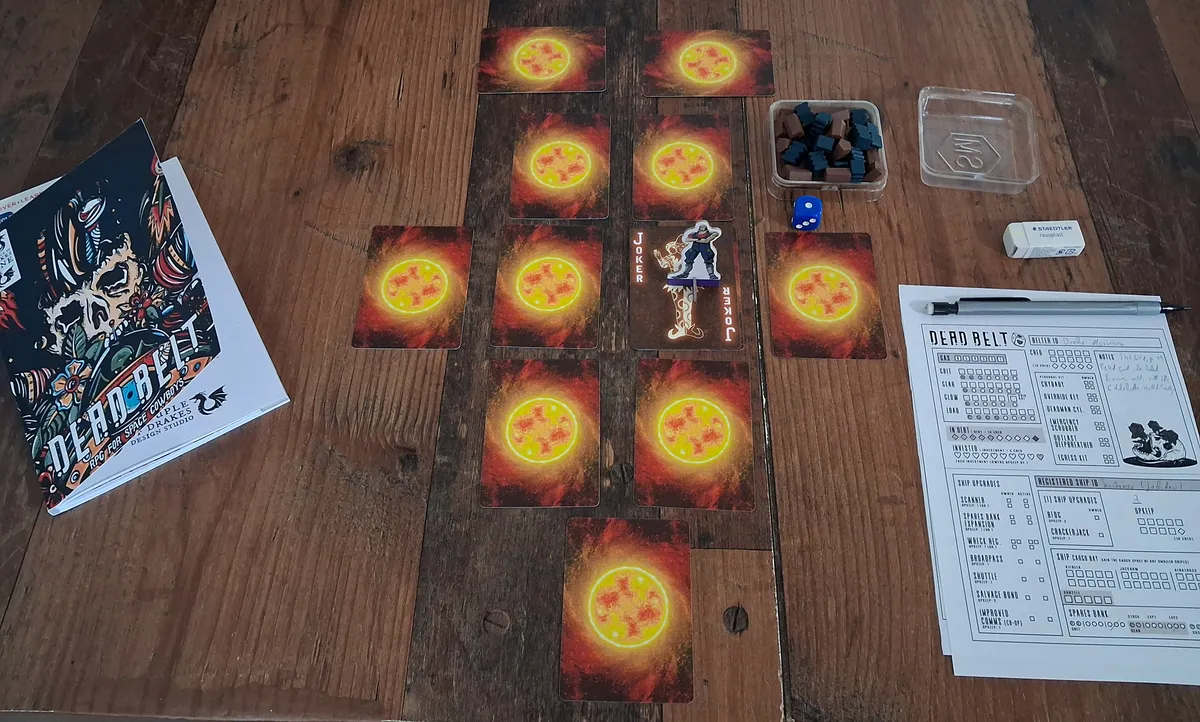 A game of Dead Belt, something that works so much better on an actual table than digitally.
Final Thoughts
Well, there you have it. My thoughts and my journey on becoming an active solo TTRPG player. I hope this will help some of you who read through it all, be it complete beginners, people in a struggling position, or even veterans who might or might not be able to take something of this with them. It's all about finding the right way of play, the right game and the right mindset to get you going, and to continue going (although continuing is often much easier than getting started at all in my opinion). Finally, let me reiterate what I said at the start: Just start playing. Fretting over all of this will only help you so much. Choose a game you feel good about. Get a single paragraph going, set up your world, do a single roll. Don't force yourself into a long session, just sit down for a quarter of an hour, do a single thing and see where that takes you. Creativity is a muscle that needs to be trained, so there's no shame in starting out slow, and there's no shame in staying there if it fits you.